Kafka at the Edge: Trading Consensus for Compatibility
Should you consider a streaming protocol for your IoT edge?

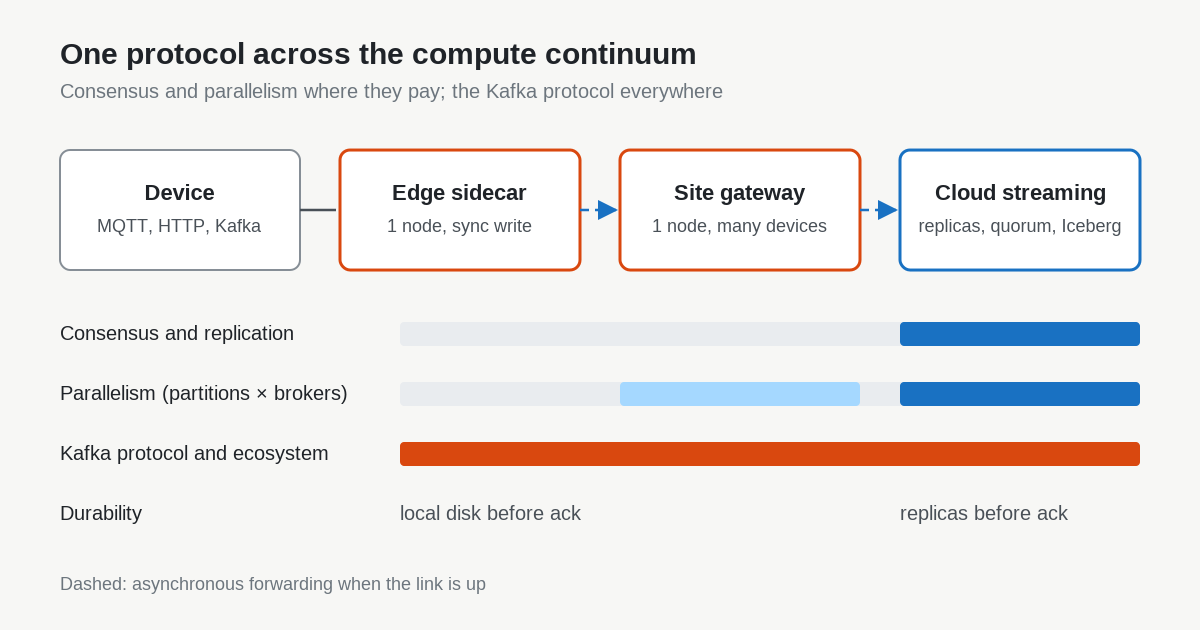
At Current 2026 in San Francisco on 5 November, my colleague Avinash Upadhyaya took Apache Kafka to the edge in a Meet-Up Hub session: a single-node broker built for unreliable networks, MQTT and HTTP beside it, and local processing to “stream, buffer, aggregate, and forward”.1
The defining property of an edge site is that its uplink fails. A plant on a leased line, a store on consumer broadband, a vehicle on cellular, a vessel on satellite: each loses its connection upstream for minutes, hours or days, and none can promise when it comes back. Everything else about edge streaming follows from that. Every edge architecture is also a decision about the compute continuum, about what runs on the device, on a gateway at the site, and in the cloud. The usual answer puts Kafka at the cloud end and something lighter, usually an MQTT broker and a bridge, everywhere else. We’ve built a different answer: Leafcuttr runs the Kafka protocol at the edge on a single node, speaks MQTT and HTTP beside it, and forwards upstream when the link is up. It gives up the consensus and the parallelism that make Kafka a distributed system and keeps everything that makes it an ecosystem.
More than 80% of the Fortune 100 use Apache Kafka, by the project’s own count, and its industry snapshot lists all ten of the ten largest companies in manufacturing, and in energy and utilities, among its users, with eight of ten in transportation and in telecoms.2 Those are the industries with the most sensors, plants, vehicles and networks. Nobody publishes a count of companies running Kafka for IoT specifically, so the honest version of the claim is narrower: in the industries that generate the most edge data, the platform that data is headed for already speaks Kafka.
The IoT stack agrees. ThingsBoard, an open-source IoT platform, lists Kafka as the queue for its incoming telemetry, and TBMQ, an MQTT broker, uses Kafka as the storage layer for its sessions and messages.3 Even systems built around MQTT land their data on Kafka, because that’s where the consumers are: stream processors, connectors to warehouses and lakes, schema registries, security tooling, and the people who know how to run them. Every hop that speaks another protocol needs a bridge, and every bridge rebuilds a slice of that ecosystem.
Two things make that pull stronger now. The lake has become an extension of the stream: Confluent’s Tableflow materialises Kafka topics as Iceberg or Delta Lake tables, and Redpanda can store a topic’s data as an Iceberg table directly.4 A record that leaves the site in the Kafka protocol reaches the lakehouse with one schema and one lineage, and a record that leaves in another protocol is translated at least once on the way. The second is an assumption we design to, and haven’t surveyed: a site gateway, or a spare slice of an industrial PC, now has room for a JVM broker. Our working budget is half a vCPU and 1 GiB of memory.
When the uplink is what fails
A site that can’t reach upstream has to hold what it produces until it can. A log is the natural shape for that. Producers keep writing locally at their own pace, and forwarding upstream is one more consumer reading from an offset. When the link drops, the consumer stops. When the link returns, it resumes from its last committed offset, so catching up is a replay of the log with no recovery procedure, and nothing about the producers changes.
The arithmetic of an outage is simple. A site producing at rate \(r\) through an outage of length \(t_{\text{out}}\) needs local storage for \(r \times t_{\text{out}}\), and with uplink bandwidth \(B\) it catches up in
\[t_{\text{catch}} = \frac{r \, t_{\text{out}}}{B - r}\]because new data keeps arriving while the backlog drains.
- Backlog at 1 MB/s through an eight-hour outage: 28.8 GB of local disk.
- Catch-up over a 5 MB/s uplink: 28.8 GB drained at 4 MB/s net, about two hours.
- The limit: as \(r\) approaches \(B\), catch-up time grows without bound, so a site that can’t send less than it produces never catches up.
That last line is why the edge also needs to reduce data before it leaves, which we come back to below. Upstream, the destination is a cloud streaming service that speaks the same protocol. Leafcuttr forwards with an in-process MirrorMaker 2 instance, so the upstream side needs nothing Leafcuttr-specific. Forwarding is marked work in progress in the current release, v0.5.3.5
The obvious objection is that the producer could hold the backlog itself. Stock Kafka clients don’t. The Java producer buffers in memory, 32 MB by default, and fails a record that isn’t delivered within delivery.timeout.ms, two minutes by default. librdkafka’s queue tops out at 100,000 messages or 1 GB and times a message out after five minutes.6 Agents that spill to disk do exist: the OpenTelemetry Collector can put its sending queue in a write-ahead log on disk, and Fluent Bit can buffer in the filesystem.7 For one application with no local readers, whose data only has to get upstream, a producer that spills to disk is simpler than a log beside it, until there’s a second producer:
- Every client changes. A spilling Kafka producer is a fork of each client you run (Java, librdkafka and the many clients built on it, Go, Rust), each with its own disk format, fsync policy, retry logic and metrics.
- The buffer is write-only. Nothing at the site can read a spill file until it drains, and the edge has local readers: detection, control loops, and the filtering that shrinks the backlog before it crosses the uplink.
- Some devices have no disk. Sensors and controllers that speak MQTT can’t spill, so something at the site holds their data anyway.
- Replays duplicate. The broker deduplicates retries by a producer ID it assigns and a per-message sequence number.8 A producer that restarts and replays its spill gets a new producer ID, so the broker can’t recognise the replay. A forwarder re-sends at most what it sent since its last offset commit.
- The fsync stays. A spill buffer that survives a power cut pays the same synchronous write as the log, in every application.
A sidecar log is that producer-side buffer moved out of the process and behind the protocol, so every client gets it without changing.
What sits in the replication path
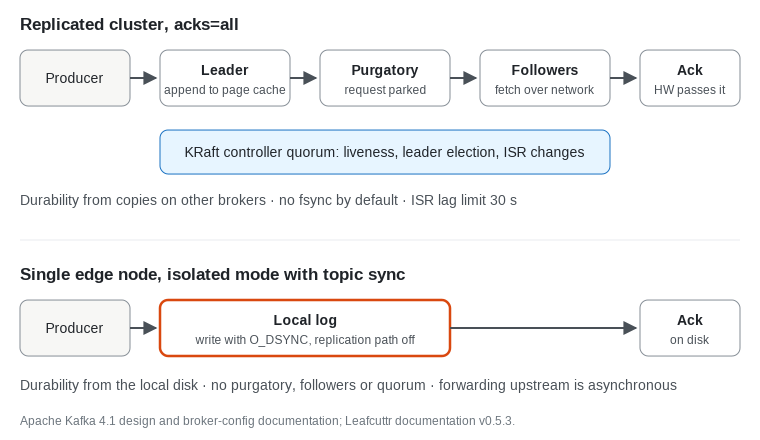
A Kafka cluster earns its complexity with two properties: availability through replication and consensus, and throughput through parallelism across many partitions and brokers. Both run through machinery that’s always on the write path in a cluster.
- Consensus. A KRaft controller quorum holds the cluster’s metadata, tracks broker liveness through heartbeats, elects partition leaders and records every change to a partition’s in-sync replica set.8
- The ISR. Each partition leader tracks which followers are in sync. A follower that hasn’t caught up to the leader’s log end within
replica.lag.time.max.ms(30 seconds by default) is removed from the set.9 - Follower fetch. Followers pull from the leader continuously, and a message counts as committed only once every in-sync replica has it and the set is at least
min.insync.replicaslarge.8 - Purgatory. A produce request with
acks=allcan’t be answered when the leader appends it, so it’s parked in the request purgatory until the in-sync replicas have fetched it or it times out.10
None of that involves fsync. Kafka writes to the filesystem “without necessarily flushing to disk”, leaving data in the page cache, and its designers rejected an fsync on every write because it “can reduce performance by two to three orders of magnitude”.8 The broker’s log.flush.interval.messages defaults to 263−1, so in practice the kernel decides when data reaches the disk.9 Kafka’s durability comes from copies on other machines.
On one node that machinery protects nothing. A single Apache Kafka broker with a replication factor of one skips the waiting, since its in-sync set is just the leader, but it still runs the controller and the replication code, and it still acknowledges from the page cache, so a power cut loses whatever the kernel hadn’t written. Leafcuttr’s isolated mode runs “an optimised code path with replication disabled”, which takes ISR tracking, follower fetch and the produce purgatory off the write path altogether.11 Topic sync then puts the guarantee back where a single node can keep it. Log segments are opened with O_DSYNC, so data is “committed to the physical medium before the producer is acknowledged”; index files still flush on the usual schedule.12 The acknowledgement waits on the local disk, the one dependency an edge site can count on.
That disk is often the weakest part of edge hardware. A synchronous write to an SD card or eMMC takes far longer than one to a datacentre SSD, and every one wears the flash. Topic sync is set per topic, lc.log.sync.always, so it belongs on the topics whose loss matters: commands, alarms and events of record. High-rate telemetry that can lose a few seconds in a power cut stays on the page cache and batches. Synced topics need storage rated for their write load, which on most sites means industrial-grade flash.
The simplest version of this design needs no new software: one Apache Kafka broker, flush.messages=1 on the topics that matter, and MirrorMaker 2 to forward.13 For a site with hardware to spare and only Kafka clients, that’s good enough. It still costs the controller beside the broker, a second JVM for the schema registry, a separate MQTT broker for the devices that can’t speak Kafka, and a write path built to be replicated, now made to fsync every message. Leafcuttr’s answer is to combine the pieces: the broker, the schema registry and the protocol listeners in one process, so a site runs fewer of them, with replication disabled and topic sync on the topics that need it.
We measured that difference on a deliberately small allocation: half a vCPU and 1 GiB of memory on a 2-vCPU host. Apache Kafka 4.0.0 and a separate schema registry shared that budget, 400 and 100 millicores and 512 MiB each, while Leafcuttr runs the broker and the registry in one process and had all of it, so part of the difference comes from running one JVM where Kafka needed two, which is the point of combining them. In the fsync runs Kafka synced every message with the topic setting flush.messages=1, and Leafcuttr used topic sync. One producer wrote 10 KB records to 12 partitions, evolving its schema as it went, three runs per case:14
- fsync on, stock producer: 3.55 MB/s for Leafcuttr against 1.96 for Kafka, with average latency of 5.5 seconds against 8.9.
- fsync on, tuned producer (200 KB batches, 100 ms linger, LZ4): 32.53 MB/s against 23.21, with a p99 of 1.77 seconds against 2.47.
- tmpfs, stock producer: 87.64 MB/s against 72.1, with a p99 of 411 ms against 753.
These are throughput runs, so the multi-second averages in the first row are mostly time records spent queued in the producer’s 32 MB buffer while the disk kept up. The runs cover the write path only. They don’t include an outage and its catch-up, forwarding, data lost in a power cut, or MQTT ingest.
A producer could get some availability back without consensus by sending each write to two or more edge brokers and treating the first acknowledgement as success. That’s leaderless replication with a write quorum of one, and it keeps writes flowing while one broker is down. Leaderless Kafka works in the cloud because its brokers share an object store that holds the durable copy. An edge site has no shared store behind its brokers, so a hedged write gives up durability: at the acknowledgement one copy exists, and a broker that fails before the others receive the record takes it with it. It also gives up the single log. Each broker assigns its own offsets, writes from several producers interleave differently on each, and partial failures leave the brokers holding different records, which every consumer pays for:
- Failing over to another copy needs offset translation or a seek by timestamp, with duplicates or a gap at the switch, because committed offsets mean nothing on the other broker.
- Reading every copy needs a producer ID and sequence on each record and dedup state in each consumer, kept for as long as the worst outage. Per-producer order can be rebuilt from the sequences; order across producers isn’t defined anywhere.
- Upstream receives each record once per copy, so the cloud deduplicates too.
That’s workable for telemetry keyed by device and timestamp, where per-device order is all that matters and every write is an upsert. Journals are another matter, since there the order is the record. Stock Apache Flink, Connect and Kafka Streams jobs don’t deduplicate across independent logs either, so a swapped-out producer brings swapped-out consumers with it. A site that has to survive a broker failure is better served by two or three brokers replicating over the site’s LAN, where the network is reliable and consensus is cheap. Consensus belongs inside the site, and the uplink is where it stops paying.
Speaking the Kafka protocol at the edge is worth the trade only if the rest of the ecosystem comes with it, starting with the contracts and the processing.
- Schemas. Leafcuttr embeds a schema registry compatible with the Confluent Schema Registry API, stored in a Kafka topic, so producers at the site register and validate schemas offline with the same serializers they’d use against the cloud.15
- Processing. Leafcuttr v1.0, the next major release, will add filters, joins and functional operators over local topics, so a site can drop noise, enrich readings with local reference data and aggregate before anything crosses the uplink.16 On a flaky or metered link, every byte filtered locally is a byte that never sits in the backlog.
- Other protocols. MQTT 3 and 5 and HTTP are accepted in the same process, with MQTT topics mapped to Kafka topics, so devices that can’t speak Kafka still land in a Kafka log without a separate broker or bridge.17
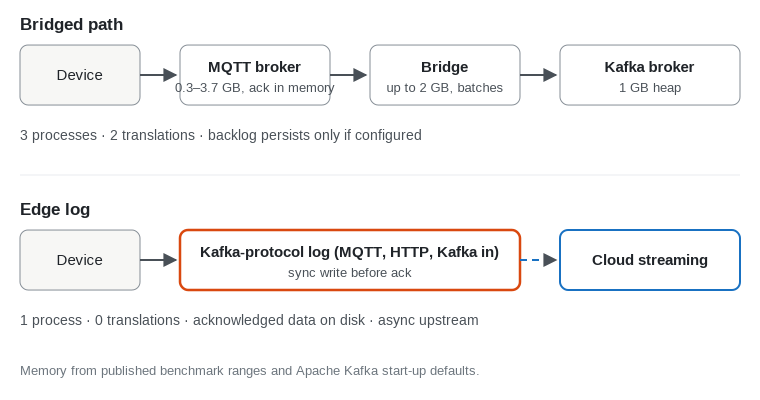
The alternative to a log at the edge is the familiar stack: an MQTT broker at the site, a bridge that consumes from it and produces to Kafka, and Kafka somewhere upstream. MQTT is good at what it does, and devices that can only speak it should keep speaking it. The extra layers still cost something.
- Compute. In an independent benchmark of eight brokers on edge-sized machines, Mosquitto used 284 to 620 MB under load, HiveMQ 487 MB to 1.7 GB and EMQX 650 MB to 3.7 GB.18 A Kafka Connect worker’s start-up script gives it a heap of up to 2 GB by default.19 Mosquitto’s measured memory plus the bridge’s default heap ceiling comes to roughly 2.3 to 2.6 GB across two runtimes. Leafcuttr ran in our benchmark with 1 GiB.
- Durability. An MQTT QoS 1 acknowledgement means the broker has the message, which may still be only in memory. Mosquitto’s persistence is off by default, and when it’s on it saves every 1,800 seconds by default.20 If the bridge stops consuming while upstream is down, the backlog queues in the broker, and a crash between saves loses up to \(r \times t_{\text{save}}\), 1.8 GB at 1 MB/s. EMQX 5.x’s own Kafka integration can buffer on disk, which survives a node restart; in memory mode the buffer is lost on a restart.21
- Latency. The broker hop is fast, with median latency of 0.21 to 0.76 ms for 1 KB messages.18 The bridge then batches like any producer, and since Kafka 4.0 a producer waits up to 5 ms by default to fill a batch.22
Tuning narrows the gap. Mosquitto with persistence on and a short autosave interval shrinks the window of loss,20 and a broker with its own Kafka integration, such as EMQX, replaces the Connect worker and most of its memory, with a disk buffer when it’s configured.21 What tuning doesn’t remove is the second protocol hop, a second store to size and watch, and the gap at the site itself: no Kafka clients, no schema registry and no local consumer reading the backlog in the protocol the cloud speaks.
The durability line matters most for the main problem. During an outage, the bridged path holds the backlog in a broker and a bridge buffer, and each persists only if someone configured it to.
Store-and-forward at the edge is an old idea, and the closest design to this one comes from NATS. A NATS leaf node is a NATS server at the site that dials out to a hub and bridges subject interest across the link. It can run its own JetStream store in a separate domain, so the site’s streams stay apart from the hub’s, with streams mirrored or sourced between the two.23 It’s a mature design, and where the cloud side isn’t Kafka, it’s the better choice. Where the cloud side is Kafka, a leaf node is one more protocol at the boundary: the site’s data still crosses a bridge to reach the stream processors, connectors and schema registry upstream, and nothing at the site speaks the protocol those tools expect.
Sidecars and journals
A site gateway fans in many devices. The other shape on the continuum is one log per workload, running beside it as a sidecar on the same host or in the same pod. Leafcuttr runs either way.24
- Streaming sidecar. An application that already produces to Kafka keeps its client and its code. A network filter redirects its Kafka traffic to the local sidecar, or injected configuration points
bootstrap.serversat localhost, so the application writes to a log on its own host and the sidecar forwards upstream when the link allows. The producer sees a local broker that’s always there, and an outage becomes backlog: the application sees no produce errors or retry storms. - Journal sidecar. An autonomous system, such as a robot, a vehicle controller or an agent, records what it saw, decided and did in a local log beside it. The journal is the audit trail while the system is offline and replays upstream when it reconnects, in order, with the same schemas the cloud consumers expect.24
Because the routing happens in the network or in injected configuration, sidecars can be rolled out the way a service mesh is, with no change to application code.
Giving up consensus is the right call when the edge node’s job is to capture, hold, shape and forward, and the system of record is upstream:
- Telemetry and store-and-forward from plants, stores, vehicles and robots, where outages are routine and a delay is acceptable but a gap isn’t.
- Bounded-time detection on network flows or sensor data, where a local consumer has to act before the cloud could.
- Agent and machine journals that must survive the time they spend offline.
- Feature and training capture for models trained centrally on edge data.
It’s the wrong call when the edge node is itself the system of record and must stay available through its own failure (replication and consensus exist for that, and the cloud should own it), when one site’s throughput needs many brokers, or when the device is too small to run a broker at all. Those devices keep speaking MQTT, to a log that accepts it. For a site already on MQTT, that’s the migration: the devices stay as they are, point at the log’s MQTT listener, and the bridge goes.
Two signals would show this is the wrong default. One is MQTT brokers shipping Kafka-protocol egress with a durable disk buffer turned on out of the box, which would close most of the durability gap and remove the separate bridge. The other is catch-up limited in practice by the cloud side, by ingest quotas or upstream consumer lag, more than by the uplink, which would make a fast local replay matter less than the arithmetic says.
-
Current 2026 San Francisco: Taking Apache Kafka to the Edge, Meet-Up Hub session, 5 November 2026. ↩
-
Apache Kafka, project home page, read November 2026. ↩
-
Confluent Cloud: Tableflow overview, “materializes Apache Kafka topics as Apache Iceberg or Delta Lake tables”; Redpanda: About Iceberg topics, v26.3, an enterprise-licensed feature. ↩
-
Leafcuttr documentation, Topic forwarding, v0.5.3:
lc.topic.forward.configpoints at a MirrorMaker 2 configuration; the feature is marked work in progress. ↩ -
Apache Kafka 4.1 producer configs:
buffer.memory33554432,delivery.timeout.ms120000; librdkafka CONFIGURATION.md:queue.buffering.max.messages100000,queue.buffering.max.kbytes1048576,message.timeout.ms300000. ↩ -
OpenTelemetry Collector: resiliency, persistent sending queue with the
file_storageextension; Fluent Bit: buffering and storage. ↩ -
Apache Kafka 4.1 documentation: Design, sections on persistence and replication. ↩ ↩2 ↩3 ↩4
-
Apache Kafka 4.1 documentation: Broker configs:
replica.lag.time.max.msdefault 30000;log.flush.interval.messagesandlog.flush.scheduler.interval.msdefault 9223372036854775807. ↩ ↩2 -
Yasuhiro Matsuda, Apache Kafka, Purgatory, and Hierarchical Timing Wheels, October 2015; the mechanism is unchanged in Kafka 4.1. ↩
-
Leafcuttr: Isolated mode, documentation v0.5.3. ↩
-
Apache Kafka 4.1 documentation: Topic configs:
flush.messages“allows specifying an interval at which we will force an fsync of data written to the log”; 1 forces an fsync after every message. ↩ -
Our own benchmark, summarised at Leafcuttr benchmarks:
apache/kafka:4.0.0at 400m CPU, 512 MiB and a 460 MB heap plus a schema registry at 100m and 512 MiB, against Leafcuttr lc-0.4 at 500m, 1 GiB and a 920 MB heap, on a 2-vCPU, 8 GB host; 10,000-byte records, 12 partitions, one producer; Kafka fsync rows with topicflush.messages=1; averages of three runs. ↩ -
Leafcuttr: Schema registry:
lc.schema.registry.enable, default port 8081, schemas stored in the_schemastopic; Avro is the primary format. ↩ -
Leafcuttr features: filtering, forwarding and aggregation listed as coming in v1.0. ↩
-
Leafcuttr: MQTT broker and proxy; MQTT 3 and 5. ↩
-
Paul et al., Benchmarking message brokers for IoT edge computing, March 2026: eight brokers (Kafka not among them) on 1, 2 and 4 vCPU virtual machines; memory under load and median latency for 1 KB messages on 4 vCPUs. ↩ ↩2
-
bin/connect-distributed.sh:-Xms256M -Xmx2Gwhen no heap is set;bin/kafka-server-start.shgives a broker-Xmx1G -Xms1G. ↩ -
mosquitto.conf(5):
persistencedefaults to false;autosave_intervaldefaults to 1,800 seconds. ↩ ↩2 -
EMQX: Stream MQTT data into Apache Kafka, buffer mode: memory, disk or hybrid; disk survives a node restart, memory doesn’t. ↩ ↩2
-
NATS documentation: Leaf nodes, including JetStream domains over a leaf and mirrors and sources across it. ↩
-
Leafcuttr deployment modes: gateway, sidecar or embedded, and agent journal. ↩ ↩2
Thanks for reading The Write Ahead Log
Subscribe for free to receive new posts.