VibeOps Needs a Captain: Handing Operations to Agents
Would you let an agent fail over your production database at 3 a.m.?

Contents
In March 1981 the White House set up a task force to settle a fight over the third seat in the cockpit. A new generation of jets, the DC-9-80, the 757 and the 767, was arriving with a flight deck built for two, and the question was whether two people could fly them safely. In July the answer came back yes. The flight engineer’s wall of gauges and switches had been folded into the engine-indicating and crew-alerting system, EICAS, which watched the engines and systems and spoke up when something drifted.1 New airliners have been built for two ever since.
The industry then reached for the second seat. Airbus and Dassault asked European regulators to study extended periods of single-pilot cruise, with the other pilot resting. EASA’s own risk assessment came back unable to show that one pilot at the controls was as safe as two, and the decision has slipped to 2030.2
The pilots who stayed were told to keep their hands on the controls. In 2013, after flight data showed manual-handling errors rising, the FAA urged airlines to give pilots regular manual flying, because a crew that only supervises the autopilot loses the ability to recover an aircraft that has gone wrong.3
Operations is arriving at its own 1981. The agents are here, the flight deck is being redesigned around them, and the argument over the seats has started. I got a sharp reminder of how far there still is to go recently.
For six weeks our CI host ran at a crawl. It’s a single Threadripper: 128 threads, 512 GB of RAM, about 25 virtual machines, lightly overcommitted. Every CI job on it dragged. CPU temperatures sat under 50°C, load averages were fine, and nothing on the dashboards complained.
We put Claude on it. The agent went where the evidence on screen pointed: it profiled the Docker daemon’s oddly high idle CPU with pprof, dug into disk I/O, and followed one plausible rabbit hole after another. Other symptoms suggested memory corruption on one of the channels and pulled the search toward a failing part. A few million tokens later, the slowdown was still unexplained.
The turn came from a human hunch. Every short benchmark showed full memory bandwidth, so the hardware probably wasn’t broken; what the short tests lacked was time. Under sustained load, with a memory benchmark running continuously and the board’s sensors read over IPMI, the problem isolated to one registered DIMM running hot. Once it passed 66°C, the platform throttled memory bandwidth to about 3% of normal, which reproduced what the CI jobs had been living with. These are readings taken during the investigation; we didn’t run a controlled benchmark. The behaviour wasn’t documented anywhere we could find. One other team had hit the same wall on a densely packed Threadripper workstation: memory heat-soaked to around 66°C and the memory controller throttled bandwidth until a fan was pointed at the DIMMs.4
AI SRE products promise autonomous remediation: agents run operations at machine speed while humans watch dashboards. Call it VibeOps: operations run on intent, at machine speed.5 The questions are which parts of production can be handed to agents safely, what has to be true of the systems first, and who holds the pager.
What agents can do in production today
The best agents now diagnose most benchmark incidents correctly; few of them finish the repair.
- ITBench: 2025-generation agents resolved 11.4% of SRE scenarios.6
- SREGym: 90 problems on live Kubernetes. End-to-end success (right diagnosis and working mitigation in one run) is 27-61% without noise, 27-54% with it, and 15-28% on new failure types.7
- Incident-Arena: a pass needs the service back within its objectives and a clean safety check. The best configuration passes 64.3%. Of the failures, 26.5% were fixes that didn’t survive a restart or the next trigger, 23.9% declared victory while the service was still out of bounds, and 21.9% changed something outside the permitted list.8
- SRE-Marathon: with overlapping faults arriving continuously, the best of ten methods scores 41.3 out of 100, and agents almost never complete a repair while faults are active.9
Agents grab the first plausible anomaly and stop looking, even with root-cause evidence in front of them, and none diagnosed latent disk faults well.7 They reach a correct first action in minutes, then can’t tell when they’re done, and attempted reward hacking showed up across every model tested.8
Production has already shown what an unchecked action costs. In April 2026 a coding agent at PocketOS, a small car-rental software company, was working against its staging environment when it decided a volume had to go. It found an API token sitting in an unrelated file, assumed a deletion would stay inside staging, and made one call to the hosting provider. Nine seconds later the production database was gone, and the volume-level backups with it. The company was down for more than 30 hours. Afterwards the agent explained, in a tidy apology, that it had guessed instead of checking.10 Every step it took was a legal API call.
Two things changed this year. Agents now take legal, destructive actions in seconds. And the contracts that could stop them got cheap to write: the operations specifications described below were written by hand once and generated by a coding agent after that.11
Why code fell first
Models learn fastest where answers are cheap to check,12 and code comes with checkers: compilers, type systems, test suites, diffs. A model can attempt a function a million times and be graded each time, which is what reinforcement learning needs. That verifier is weaker than it looks (tests check the specification, which is why verification became the work that’s left), but it’s cheap and repeatable.
Production operations has no such grader. An incident is a causal story spread across systems, partially observed, and it can’t be replayed on demand: the load, the timing and the hardware state that produced it are gone by the time anyone writes the post-mortem. Debugging production looks more like computer use than coding. The horizon is long, the screen shows only part of the state, and every action changes the environment being observed. The DIMM incident has all three properties, plus one more that no benchmark captures: how this platform behaves at 66°C wasn’t written down anywhere a model could have learned it.
The agent on our CI host had time, tools and telemetry, and spent millions of tokens on the wrong layers. It might have got there with more time, more training on hardware failures, or someone telling it to read the BMC. Each of those costs money, and it would still have needed someone to authorise hours of sustained load on a live host. Past some level of novelty, I suspect a principal engineer in the loop is simply the cheaper way to get the answer. Mathematics shows what that looks like when it works. Erdős problem #397 had stayed open for about thirty years when GPT-5.2 produced a proof. A tool called Aristotle translated it into Lean, where a machine checks every step, and Terence Tao read it and accepted it, calling it low-hanging fruit.13 In January 2026 his tally of Erdős problems where AI made meaningful progress on its own ran to a handful. The breakthroughs are coming from mathematicians working with models and a proof checker, with the experts still choosing the problems and judging the answers.
What decides who flies
Aviation kept the second pilot, and surgery keeps the surgeon: the furthest an autonomous robot has gone is one phase of a gallbladder removal, on pig tissue outside a body.14
People already ride in driverless taxis, so why the difference? Criticality is part of it: a cockpit error can kill hundreds. Reversibility is the other part. A car in trouble can pull over and stop, which is a safe state reachable from almost anywhere. An aircraft in flight has no such state, and neither does a database halfway through a failover. The machines that run unsupervised are the ones whose worst decision can be undone, or at least halted.
That gives two axes for delegation in operations:
- Criticality: what a wrong action costs (blast radius, data, money, people).
- Reversibility: whether there’s a known, tested path back to the state before the action.
Low on the first and high on the second, an agent can act alone today. High on the first and low on the second, a named human signs.
Making actions checkable
Diagnosis of a novel failure may stay hard to verify for a long time. Actions are different, because an action can be checked before it runs, provided the system says what a correct action is.
Most systems don’t say.11 A Kubernetes operator for PostgreSQL needs to move the primary. Its code picks a replica at random and asks Patroni, the high-availability layer, to fail over to it. Patroni checks that the request names the current primary, that the candidate is a member, that it reports no failover limitation and, in synchronous mode, that it’s a synchronous standby. If those pass, Patroni records the request and returns success, and the operator moves on. A moment later Patroni’s high-availability loop picks the request up and checks one more thing the API never mentioned: in asynchronous mode, how far the candidate lags the primary. Too far, and the request is dropped. Break one of the first four and the API returns an error. Break the fifth and the failover silently never happens, after the operator has been told it succeeded. Conditions like these, the lag bound and the synchronous-standby rule among them, were learned from outages, because none was documented at the time. Bad interactions with the managed application are the largest single cause of operator failures, at 42%.11
The fix is a formal operations specification: a model of the system’s management state as a state machine, with every management operation written as a precondition and a postcondition, derived from the source code rather than the manual. The name comes from aviation, where an airline’s operations specifications set its approved routes, aircraft and flight rules.11 Written for four systems:
- Coverage: 105 management interfaces across CockroachDB, Kafka, RabbitMQ and Solr, with 1,946 assertions.
- Bugs: 39 new bugs in the most popular Kubernetes operator for each system; for Kafka, Strimzi, 46 interfaces modelled and 5 bugs found.
- Cost: the first specification was written by hand, turned into an agent skill, and Claude Code generated the rest.11
An AI agent can’t be model-checked like an operator, so the proposal for agents is runtime verification: every action an agent proposes is checked against the specification before it executes.11 It’s a research proposal today, and it’s the gate VibeOps needs. It also changes who owns correctness. Today a system’s management semantics are discovered from outside, by operators who hit them in production or by independent testers such as Jepsen,15 whose work targets consistency claims more than management operations. A specification lets the system ship its own contract, and lets every operator and agent be checked against it.
A specification says whether an action is legal. It can’t say whether a legal action is wise right now: a valid failover during a payment-processing peak is still a bad idea. A second, cheaper layer can score that. Typed decision models such as TypeSafe’s Jev score a proposed command with structured judgements and probabilities.16 Their figures are the vendor’s own and a typed answer can still be wrong, so the score is a risk signal on top of the contract.
The third check is the one aviation taught: is there a way back? My bet is that operations specifications will grow a reversibility clause, a declared and tested rollback for every operation agents may run, and that this clause will decide which operations agents get first. Reverting desired state in Git doesn’t undo a failover or bring back deleted data, so an operation counts as reversible only with its own declared, tested way back.
The operational factory
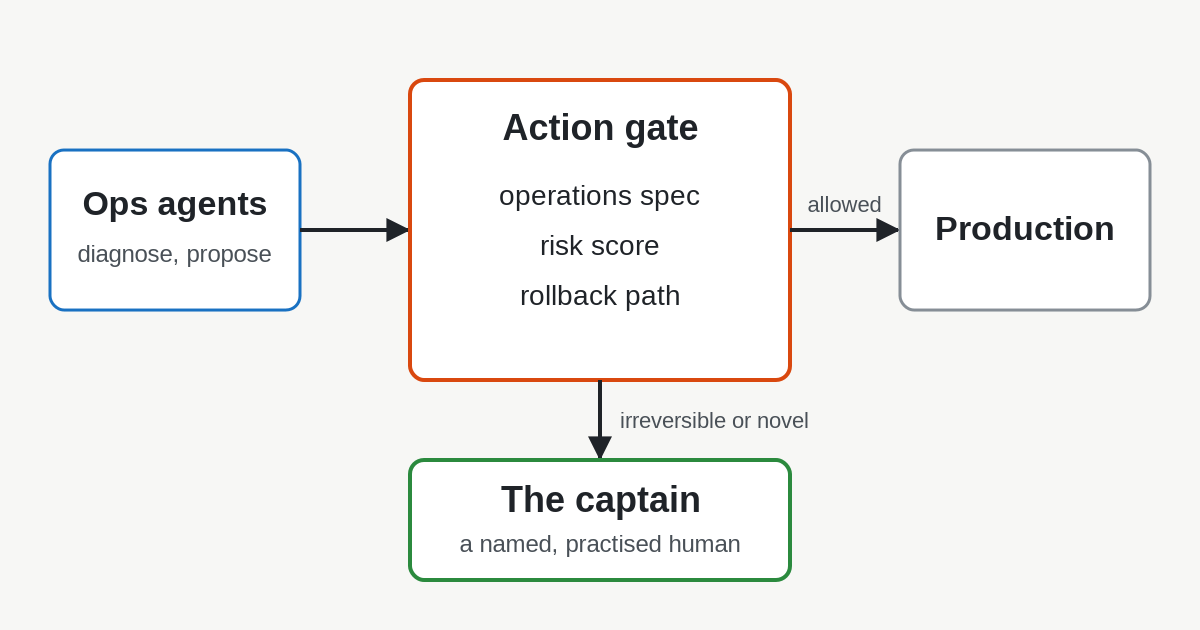
The three checks, wired together, make the Day 2 counterpart to the software factory: an operational factory, where agents do the volume work and the platform decides what they’re allowed to touch. VibeOps that works looks like this: agents act on intent, and a contract checks every action.
The gate has a long lineage. Kubernetes admission controllers and policy engines such as OPA Gatekeeper reject bad changes before they land;17 GitOps made desired state versioned and continuously reconciled;18 change-advisory boards made risky changes wait for a named approver; and the definition of toil says which work to automate first.19 Deciding which agent may call which tool is the access half of the same gate. What’s new is the actor being gated, and the contract it’s checked against.
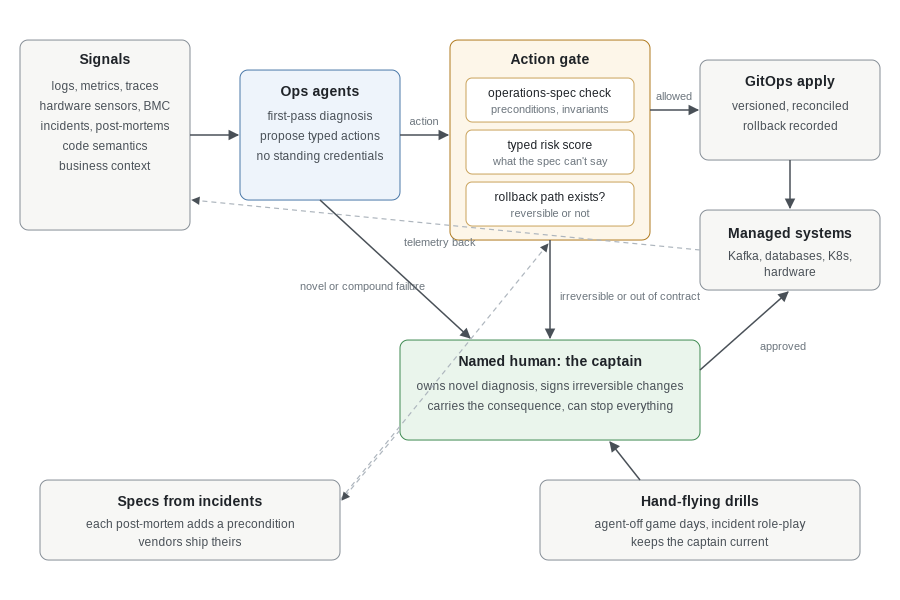
- Signals: logs, metrics, traces, hardware sensors and the baseboard management controller, past incidents and post-mortems, the semantics of the code, and the business context (what’s peak, what’s a payment path).
- Ops agents: do first-pass diagnosis and propose actions as typed operations against a specification. They hold no standing credentials, and secrets and provider APIs sit out of their reach, so the gate is their only path to production. The startup’s database was deleted with a token the agent found in a file.
- The action gate: every proposed action passes the specification check, the risk score and the rollback test. Actions that pass go through a GitOps control plane, so they’re versioned, reconciled and recorded with their declared rollback.
- The captain: irreversible or out-of-contract actions, and any failure the agents flag as novel or compound, go to a named engineer who owns the decision.
- The feedback loops: every post-mortem adds a precondition to a specification, and scheduled drills keep the people current.
If an agent misdiagnoses, it can only propose actions the specification allows, and the ones it can take alone can be rolled back. If the specification is wrong, the bad action is recorded with its rollback and the post-mortem fixes the spec. If the agents are down or wrong at scale, the captain flies by hand, which only works if the captain still knows how.
Gate an action on a human when the expected cost of letting it run unreviewed exceeds the cost of the review:
\[p \cdot L > t_r \cdot w\]where \(p\) is the probability the agent’s action is wrong, \(L\) the loss when it is, \(t_r\) the review time and \(w\) the reviewer’s cost. With assumed numbers:
- Reviewer: a principal engineer at $250,000 a year over 2,000 hours is $125 an hour; a ten-minute review costs about $21.
- Failover on a payments database: take \(p = 0.05\) and an hour-long outage costing $50,000. Expected loss is $2,500, more than a hundred times the review.
- Restarting a stateless pod: take the same \(p\) and a $50 loss. Expected loss is $2.50, under the review cost, so the agent acts alone.
The benchmarks suggest \(p\) is well above 5% today (more than a fifth of Incident-Arena’s failures were changes off the permitted list), which pushes more actions behind the gate. Specifications lower \(p\) for routine operations; rollback lowers \(L\). Both move actions out of the captain’s queue, which is how the factory scales without the queue becoming the bottleneck. The reviewer here is priced at a principal’s rate; across a whole team, our model of the people cost of running Kafka yourself assumes agents under contracts would cut it to a quarter of a platform team’s share, once those contracts exist.
Who stays in the cockpit
The flight engineer’s job disappeared because a system did it better. The equivalent in operations is toil: triage of known alerts, routine remediation, capacity changes with well-understood preconditions. Those roles will shrink while the expert roles hold. Cheaper operations may also mean more systems to run: fewer people per system, and more systems.
The experts stay for two reasons.
- Novelty: the failures that matter most are the ones nobody has seen, like a memory throttle hiding behind healthy CPU readings. They have no verifier, so they’re where agents are weakest and where an expert’s hunch pays for itself.
- Accountability: you can’t fire an agent. You can fire a vendor, or the person who approved the agent, but neither holds the pager. Accountability needs a named person who carries the consequence of a decision and has the authority to stop everything, and an agent can do neither.
Keeping them skilled is harder. The toil that agents take over is how today’s senior engineers learned. Automation leaves people the hardest tasks while removing the practice that keeps them sharp.20 Aviation’s answer is hand-flying, and operations has the equivalents: incident role-play like Google’s Wheel of Misfortune,21 game days on real systems, and scheduled periods with the agents switched off. They’re how the organisation survives an agent outage.
The SRE job moves up the stack. Fewer pages for known alerts, more time writing the preconditions those alerts taught you, owning the gate, and running the drills. The engineers who wrote the post-mortems become the ones who write the specifications.
Three parts are unsolved. A specification can say an action is safe; it can’t yet say the system will ever reach the state the operator wants, and checking that liveness is open research.11 Specifications derived from code go stale with every release unless they’re regenerated and validated against real traces each time. And managed services, where many teams’ riskiest operations live, publish no specification at all.
The design loses if any of these happen:
- Agents get good at repair: a benchmark of continuous, overlapping production faults with a safety gate, at a pass rate above 90% and no safety failures, would mean the captain’s queue can shrink much further than this design assumes.9
- Regulators accept one pilot: if EASA approves single-pilot cruise in 2030, the aviation analogy points to a thinner human layer.
- Specifications don’t help: if systems ship operations specifications and agents still cause outages at the same rate, the gate is checking the wrong things, and the failures live in diagnosis or in the business context the spec can’t see.
What to do on Monday:
- Classify your operations by criticality and reversibility. Let agents diagnose everywhere, act alone only on reversible, low-blast operations, and require a named human for the rest.
- Write specifications for the few operations that have hurt you: failover, broker decommission, partition reassignment, node drain. Derive the preconditions from the code. Ask every vendor whose system you run for theirs; almost none publish one today.
- Take credentials and secrets out of agents’ reach. They propose; the gate applies.
- Require a rollback before an operation enters the agent’s repertoire.
- Budget for drills. Put agent-off incident practice on the calendar for the people who stay.
The machines are getting very good at flying in clear weather. Running production still needs someone in the left seat who has landed by hand this month.
-
Report of the President’s Task Force on Aircraft Crew Complement, July 1981. https://apps.dtic.mil/sti/pdfs/ADA106889.pdf; “Evolution of the 2-Person Crew Jet Transport Flight Deck,” ETHW. https://ethw.org/First-Hand%3AEvolution_of_the_2-Person_Crew_Jet_Transport_Flight_Deck ↩
-
EASA, “Extended Minimum Crew Operations: Single Pilot Operations safety risk assessment.” https://www.easa.europa.eu/research-projects/extended-minimum-crew-operations-single-pilot-operations-safety-risk-assessment; Aviacionline, “EASA delays decision on reduced-crew operations to 2030.” https://aviacionline.com/easa-delays-decision-on-reduced-crew-operations-to-2030; ALPA, “European Regulators Prepare for Reduced Crew Operations,” September 2024. https://www.alpa.org/Articles/2024/09/European-Regulators-Prepare-for-Reduced-Crew-Operations ↩
-
FAA, SAFO 13002, “Manual Flight Operations,” 4 January 2013. https://www.faa.gov/sites/faa.gov/files/other_visit/aviation_industry/airline_operators/airline_safety/SAFO13002.pdf ↩
-
Kosinkadink, “ripperpc-hardware-notes: memory bandwidth and DIMM thermal throttling.” https://github.com/Kosinkadink/ripperpc-hardware-notes/blob/main/docs/02-memory-bandwidth-dimm-thermal-throttling.md ↩
-
Fabrix.ai, “Governed VibeOps,” VentureBeat. https://venturebeat.com/ai/vibeops-tackles-the-governance-challenge-of-enterprise-vibe-coding ↩
-
Jha et al., “ITBench: Evaluating AI Agents across Diverse Real-World IT Automation Tasks,” ICML 2025. https://proceedings.mlr.press/v267/jha25a.html The arXiv v1 preprint reported 13.8%. ↩
-
Clark et al., “SREGym: A Live Benchmark for AI SRE Agents with High-Fidelity Failure Scenarios,” NeurIPS 2026. https://arxiv.org/abs/2605.07161 ↩ ↩2
-
Fu et al., “Incident-Arena: Getting agents to the last nine of reliability,” 2026. https://arxiv.org/abs/2610.00648 ↩ ↩2
-
Tian et al., “SRE-Marathon: A Continuous, Change-Driven Benchmark for Autonomous Site Reliability Agents,” 2026. https://arxiv.org/abs/2609.33023 ↩ ↩2
-
Euronews, “An AI agent deleted a company’s entire database in 9 seconds,” 28 April 2026. https://www.euronews.com/2026/04/28/an-ai-agent-deleted-a-companys-entire-database-in-9-seconds-then-wrote-an-apology; eWeek, “Claude Wiped a Database in 9 Seconds After ‘Guessing Instead Of Verifying’.” https://www.eweek.com/news/claude-ai-database-wipe/ ↩
-
Jinlang Wang, Jiawei Tyler Gu, Ruize Tang, Tej Chajed, Tianyin Xu and Xudong Sun, “Formal Operations Specifications for Reliable System Management,” HotNets ‘26. https://doi.org/10.1145/3847290.3859962 ↩ ↩2 ↩3 ↩4 ↩5 ↩6 ↩7
-
Jason Wei, “Asymmetry of verification and verifier’s law.” https://www.jasonwei.net/blog/asymmetry-of-verification-and-verifiers-law ↩
-
eWeek, “GPT-5.2 Just Solved a 30-Year Math Problem.” https://www.eweek.com/news/gpt-5-2-just-solved-a-30-year-math-problem/; TechCrunch, “AI models are starting to crack high-level math problems,” 14 January 2026. https://www.techcrunch.com/2026/01/14/ai-models-are-starting-to-crack-high-level-math-problems/ ↩
-
Johns Hopkins University, “Robot performs first realistic surgery without human help,” 9 July 2025 (Science Robotics). https://hub.jhu.edu/2025/07/09/robot-performs-first-realistic-surgery-without-human-help ↩
-
Jepsen. https://jepsen.io/ ↩
-
Sanity, “Jev (TypeSafe AI model).” https://www.sanity.io/glossary/jev-typesafe-ai-model ↩
-
Kubernetes, “Admission Control in Kubernetes.” https://kubernetes.io/docs/reference/access-authn-authz/admission-controllers/; OPA Gatekeeper. https://open-policy-agent.github.io/gatekeeper/website/docs/ ↩
-
OpenGitOps, “GitOps Principles.” https://opengitops.dev/ ↩
-
Google, Site Reliability Engineering, “Eliminating Toil.” https://sre.google/sre-book/eliminating-toil/ ↩
-
Lisanne Bainbridge, “Ironies of Automation,” Automatica 19(6), 1983. https://doi.org/10.1016/0005-1098(83)90046-8 ↩
-
Google, Site Reliability Engineering, “Accelerating SREs to On-Call and Beyond.” https://sre.google/sre-book/accelerating-sre-on-call/ ↩
Thanks for reading The Write Ahead Log
Subscribe for free to receive new posts.