Where Should Your Data Live? Local NVMe, Object Storage and the Memory Hierarchy
"Local NVMe or S3?" is the wrong question. Decide which tier holds the truth, which tiers cache it, and what a miss costs.

Contents
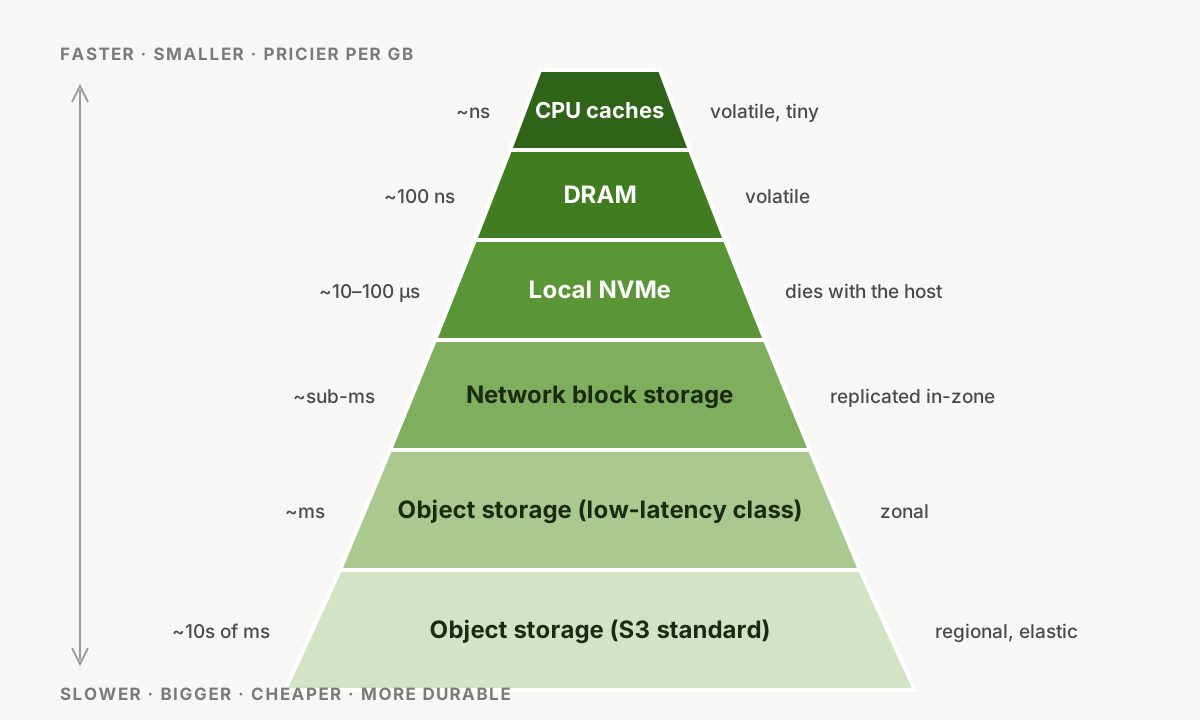
“Local NVMe or object storage?” is a false binary. Every storage system is a memory hierarchy. The real decisions: which tier is the source of truth, which tiers are caches, what a miss costs at each boundary.
Ref: thread on X
1. The two designs converge
| Local-disk design | Object-store design | |
|---|---|---|
| Hot reads | RAM → local NVMe | RAM → local NVMe cache |
| Miss | Local NVMe, µs | Object store, ms |
| Durable commit | Replicate cross-zone, then ack | Write to object store, then ack |
| Source of truth | Replicated local disks | Object store |
| Weak spot | Fixed capacity, slow rebuilds | Tail latency, cold caches |
Same working set, same single round trip per durable write. They differ only in where truth lives, the cost of a miss, and the cost of capacity and recovery.
2. Every tier becomes a cache
DRAM → cache for disk. Disk → cache for tape. SSDs made the network the bottleneck of network storage. Now local NVMe → cache for object storage (diagram above).
Each tier down: ~10× slower; buys capacity, durability, elasticity or $/GB. Put each byte on the cheapest tier that meets its latency budget; make misses rare and cheap. Numbers: our napkin math.
3. Reads: working set decides
or network block storage
~sub-ms] SRC --> O[Object storage
~ms to 10s of ms]
| Working set | Implication |
|---|---|
| Fits in RAM | Storage tier barely matters |
| Fits local NVMe, not RAM | Local flash decides; either design provides it |
| Wide, random (big keyspace, cold scans) | Misses dominate p99/p999; local NVMe’s flat tail wins |
Metric: hit ratio per tier boundary, not instance type.
4. Writes: durability costs one round trip
Cross-zone replication vs object-store write. Deciders:
- Store write latency: standard object storage ~10s of ms; low-latency zonal classes single-digit ms, at the cost of multi-zone durability.
- Batching: amortises latency and request cost; adds per-write latency.
- Cost: cross-zone replication traffic is billed; one regional write isn’t. Object-store-first wins for high-volume, log-shaped data.
5. Object storage: best bottom tier, not a system
Gives: managed multi-zone durability; small immutable interface (now with conditional writes) that pushes designs log-structured; elastic capacity; recovery becomes cache warm-up, not data copy; cheap per GB, costly per request.
Doesn’t give, and you still own:
- RAM/NVMe cache sizing, eviction, cold restarts (usually mid-incident)
- Metadata: object set, ordering, writer fencing (typically consensus-backed)
- Compaction and GC (else read amplification and a big bill)
- Miss-path behaviour: rate limits, throttling, tails
Simpler capacity and durability; not a simpler system. On-call moves to the cache and metadata layers.
6. Streaming already did this
- Tiered storage (KIP-405): hot segments local, cold in object storage.
- Diskless (KIP-1150, object-store-native Kafka-compatibles): write path on object storage; higher produce latency for no cross-zone replication traffic and near-stateless brokers.
Choose per workload, not per cluster:
| Workload | Latency budget | Source of truth |
|---|---|---|
| Payments, orders, control plane | Low 10s of ms, tight p99 | Replicated local disks + tiered history |
| CDC into analytics | Seconds | Tiered or diskless, by volume |
| Logs, metrics, clickstream | Seconds–minutes | Object-store-first |
| Long-term replay | Throughput | Object storage behind a cache |
7. Checklist
- Working-set size vs RAM and NVMe per node (measured)
- Miss rate per tier boundary and latency behind it
- p99/p999 budget
- Round trips per durable write; batching tolerance
- Recovery: rebuild from peers or warm from store? Duration, degradation
- Cost: IOPS caps, provisioned throughput, cross-zone transfer, per-request charges
- Owner of the cache, metadata and compaction
Takeaway
Miss-heavy OLTP: local NVMe. High-volume logs: cached object storage. Durability costs a round trip either way. Pick the tier that holds the truth; cache the rest; keep misses rare and cheap.
Thanks for reading The Write Ahead Log
Subscribe for free to receive new posts.